

Hans Prinzhorn and the Beauty That Survived
There are some books that feel less like ordinary collections and more like preserved pieces of humanity. For me, Artistry of the Mentally Ill was one of those books. I stumbled upon the work of Hans Prinzhorn almost by accident while researching unusual artwork and outsider art collections. The deeper I looked into it, the more fascinated I became, not only by the artwork itself, but by the compassion and preservation behind the project. Hans Prinzhorn was a German psychiatrist and art historian who became widely known for collecting artwork created by psychiatric patients during the early 1900s. Instead of dismissing these individuals as “broken” or incapable of meaningful expression, he treated their creations as important works deserving of study, preservation, and appreciation. That alone feels incredibly significant. Especially during a time period when many institutionalized people were ignored, misunderstood, or hidden away from society.
The Original Book
Prinzhorn eventually published his findings and collection in a German book titled Bildnerei der Geisteskranken in 1922, which roughly translates to Artistry of the Mentally Ill. The collection included drawings, paintings, writings, textile work, sculptures, and deeply personal visual expressions created by patients living inside psychiatric institutions. Some of the artists were able to communicate clearly. Others struggled heavily with reality, language, or social connection. Some works were signed. Others were simply labeled as: “Unknown Patient” or “Untitled”. And honestly, that is one of the things that affected me the most emotionally while looking through these books. Some of these individuals may have wandered through life feeling completely unseen or unable to properly communicate what they were experiencing internally. Yet through art, they still managed to leave behind something lasting. A piece of themselves survived.

The Witch
One of the most recognizable works from the collection is often referred to online as The Witch’s Head by August Natterer 1915. It has become one of the more widely circulated pieces associated with the Prinzhorn Collection.
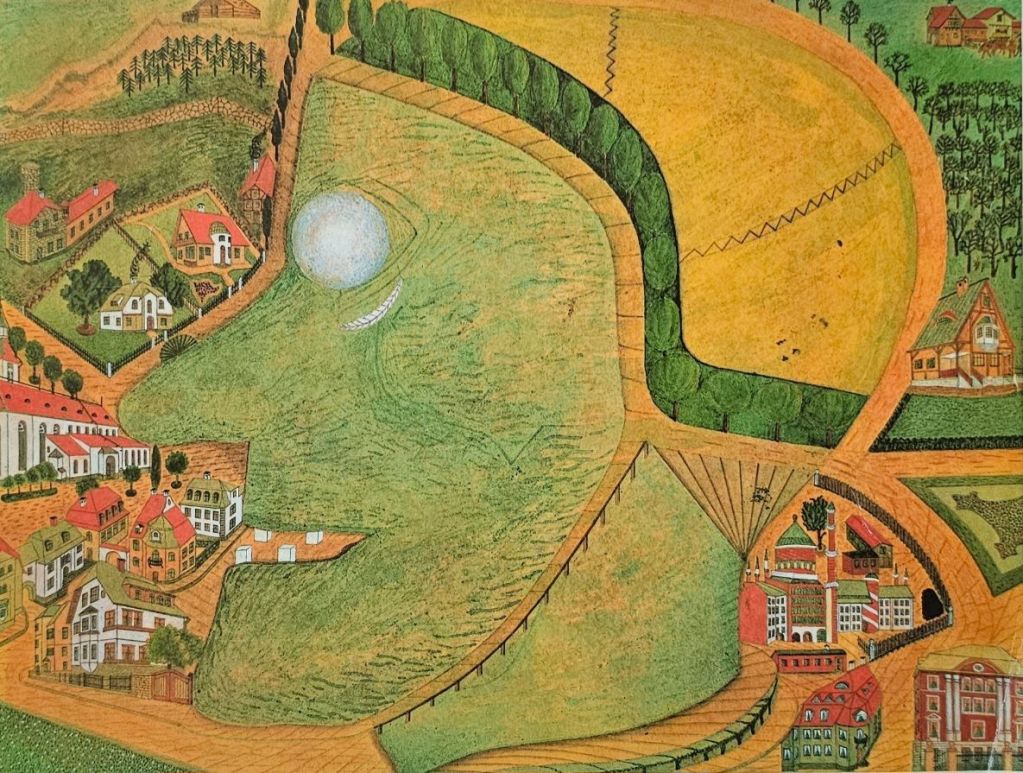
The patient who created it reportedly described having flashes of images constantly appearing before his eyes, which inspired the drawing. That detail alone makes the piece feel incredibly haunting. Not haunting in a horror movie sense. More in the sense that you are witnessing someone trying to visually communicate an overwhelming internal experience that words may not have been capable of explaining. And honestly, that is part of what makes this collection so powerful. These works are not simply “interesting drawings.” They are windows into human minds attempting to express fear, beauty, confusion, memory, symbolism, religion, loneliness, imagination, or identity through whatever means they still had available to them.
Why This Collection Matters So Much
What makes Hans Prinzhorn’s work feel so noble to me is that he acknowledged value in people society often discarded. He preserved their creativity. He gave their artwork legitimacy. He allowed people who may have otherwise been forgotten completely to leave behind something permanent. And I think there is something deeply beautiful about that. One of the biggest takeaways I had while looking through these books was realizing: even during extremely difficult periods of life, people are still capable of creating meaningful things.
- Even inside institutions
- Even during confusion
- Even during emotional suffering
- Even while struggling to communicate
- Creativity still existed
That realization genuinely stayed with me. Sometimes people assume creativity only comes from stable or ideal conditions, but these books completely challenge that idea. Some of the works feel fragile, emotional, surreal, symbolic, or deeply personal in ways that are difficult to fully explain. And honestly, that is probably why they resonate with so many artists.
The Nazis and “Degenerate Art”
Unfortunately, the history surrounding these works becomes much darker later on. During the rise of Nazi Germany in the 1930s, modern art, outsider art, and experimental artistic expression were increasingly condemned under the label of “degenerate art” or Entartete Kunst. The Nazis heavily promoted rigid ideals surrounding purity, normalcy, and state-approved artistic standards. Artwork created by psychiatric patients directly conflicted with those beliefs.Much of the original Prinzhorn Collection became endangered during this period.
Some works were destroyed.
Others disappeared.
Many pieces associated with outsider or psychologically unconventional art were targeted or condemned between roughly 1937 and the early 1940s during Nazi campaigns against so-called degenerate art. Honestly, when you think about it, it is incredibly fortunate that Prinzhorn’s book itself survived at all. There is always the possibility that copies could have disappeared entirely during that era as well. Thankfully, enough survived that people today can still study, appreciate, and discuss these works.
Artists Inspired by the Prinzhorn Collection
Another fascinating part of the collection’s legacy is how many later artists became inspired by it. Some openly acknowledged the influence publicly. Others were clearly inspired stylistically even if they rarely discussed it directly. Jean Dubuffet, one of the major figures connected to Art Brut and outsider art movements, openly admired artwork created outside traditional academic systems, including psychiatric patient art collections like Prinzhorn’s.
The surrealists also showed interest in psychologically driven artwork and subconscious imagery, particularly artists fascinated with dreams, symbolism, and irrational visual expression. More modern creators, writers, and illustrators continue referencing the Prinzhorn Collection today because of how emotionally raw and visually unique the works feel. You can honestly see traces of its influence scattered throughout modern gothic art, surreal illustration, experimental comics, outsider art communities, and psychological visual storytelling.
The Books Themselves


If you are interested in this collection, there are two editions that I highly recommend seeking out. The first is the 1972 English-translated version of Artistry of the Mentally Ill, which made Prinzhorn’s work much more accessible to English-speaking audiences. The second is the larger Prinzhorn Collection edition, which includes larger reproductions and additional color imagery. While not every piece appears in color, the larger scans and presentation make the artwork much easier to study and appreciate visually.
Unfortunately, both books have become fairly difficult to find. Some sellers list copies around the $100 to $200 range, while others charge dramatically more because they recognize that universities, collectors, researchers, and institutions still seek them out for reference material. Since the books are no longer actively printed, prices fluctuate heavily depending on condition and rarity.
There are also modern reprints floating around online, but one of the biggest complaints collectors and readers seem to have is that the image clarity is nowhere near as good as the original 1972 translated edition. Since so much of this collection relies on fine details, textures, crosshatching, and subtle imperfections within the artwork itself, poor print quality can really take away from the experience. A blurry reproduction simply does not have the same emotional or visual impact when compared to cleaner scans and sharper printing. Honestly, I just feel lucky that I was able to get my hands on both versions.
Why I Wanted to Share This
Even though my post arrived at the end of Mental Health Awareness Month in May, I still felt this topic was worth discussing because it says something very important about creativity and humanity.
- People are more than the worst moments of their lives.
- People are more than diagnoses.
- People are more than difficult chapters.
And sometimes artwork becomes the only way someone can communicate what they are experiencing internally. That is why Hans Prinzhorn’s collection matters so much to me. It preserved voices that may have otherwise disappeared completely.
Final Thoughts
I genuinely think this is a collection more people should seek out, even if you only get the opportunity to view it inside a university or research library. Some institutions may not allow the books to leave the building because of rarity concerns, but even flipping through a few pages is an unforgettable experience. For my own Beyond Files episode, I decided to do an unboxing and discussion of both editions. In the video, I only briefly show the most commonly circulated works online, along with three personal favorites that stood out to me emotionally and artistically.
I intentionally avoided placing the pages directly against the camera because I wanted to remain respectful regarding reproduction and copyright concerns. I wanted people to experience the books themselves rather than simply screenshotting full pages online. One of my favorite little surprises was discovering an old insert tucked inside one copy connected to a conference involving mental health discussions and psychiatric studies. It made the book feel even more alive historically, almost like a time capsule that continued traveling through different hands over the years. And honestly, I think that is the perfect way to describe this entire collection. A time capsule of people trying to express themselves the best they could through art.